




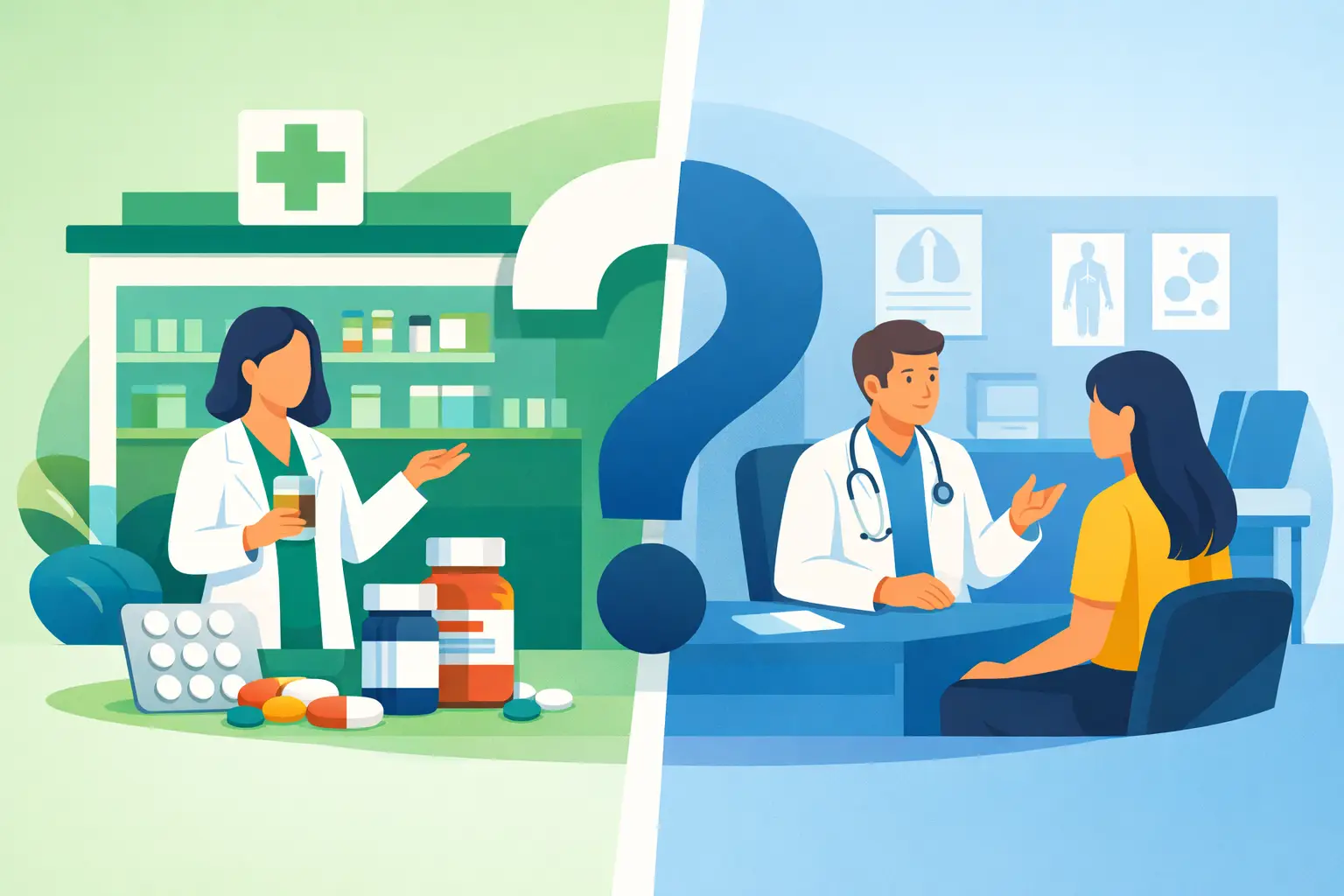
Pharmacy or GP Appointment: Which One First?
You wake up with a painful UTI, a flare-up of eczema, or a rash you were hoping would go away on its own. The real question is not just what treatment you need. It is whether a pharmacy or GP appointment is the right first step. For many everyday health concerns, choosing correctly can save time, reduce stress, and help you start treatment sooner.
A lot of people still assume the GP should be the first stop for almost everything. Sometimes that is absolutely the right call. But not always. Pharmacies now play a much bigger role in everyday healthcare, and for many common conditions they can be the faster, more practical option. The key is knowing where pharmacy support ends and where a doctor needs to step in.
When a pharmacy or GP appointment makes sense
The easiest way to think about it is this: pharmacies are often best for common, straightforward conditions, while GPs are better for diagnosis, complex symptoms, ongoing concerns, or anything that may need deeper medical investigation.
If you already know what is wrong, or your symptoms clearly fit a familiar minor condition, a pharmacy can often help quickly. That might include conditions such as thrush, cold sores, mild skin issues, emergency contraception, some allergies, and certain uncomplicated infections where pharmacy-led treatment is available. In those cases, waiting days for a doctor visit may simply add friction.
A GP appointment is usually more appropriate if your symptoms are unusual, severe, getting worse, or difficult to explain. It is also the better route if you have several health conditions, take multiple medications, are pregnant, or have symptoms that could point to something more serious.
That distinction matters because speed is not the only factor. Safety matters just as much. Good care is not about pushing everyone into the fastest route. It is about choosing the right level of care first.
What a pharmacy can help with
A regulated pharmacy service can do more than many people realize. Pharmacists are qualified healthcare professionals, and for a wide range of routine conditions they can assess symptoms, advise on treatment, and in some cases supply prescription-only medication through an appropriate consultation process.
This is especially useful when the issue is time-sensitive but not necessarily complex. If you need treatment for a common condition and want to avoid the delay and inconvenience of booking a doctor visit, pharmacy care can be a practical option.
Common reasons people choose a pharmacy first
Privacy is one of the biggest. Some health concerns are sensitive, and many adults would rather not sit in a waiting room or explain personal symptoms face to face if a secure online consultation can handle the issue appropriately.
Convenience is another. Busy professionals, parents, and people managing packed schedules often do not have the flexibility to call for a same-day appointment, wait for a callback, and then fit an in-person visit around work or childcare.
Then there is speed. For straightforward treatment requests, an online pharmacy consultation can often move much faster than a traditional appointment route. That can make a real difference when symptoms are uncomfortable and you want relief as soon as possible.
When a GP appointment is the better option
There are situations where seeing a doctor is not just preferable but necessary. If you have chest pain, shortness of breath, signs of a stroke, severe allergic reaction, heavy bleeding, or sudden severe pain, emergency care is the right response, not a pharmacy or routine GP appointment.
For non-emergency issues, a GP is still the right choice when symptoms do not fit a clear pattern or when they have been lingering without explanation. Weight loss without trying, persistent fatigue, recurring pain, blood where it should not be, or changes in bowel habits all deserve proper medical assessment.
A GP is also better placed to investigate conditions that may require blood tests, imaging, physical examination, referrals, or long-term management. If your concern is part of a bigger picture rather than a one-off issue, doctor-led care is usually the safer route.
The trade-off many patients face
The reality is that GP care offers broader diagnostic oversight, but it can take longer to access. Pharmacy care is often faster and more convenient, but it is not designed for every condition.
That is why the best choice often depends on how clear-cut the problem is. If the concern is routine and the treatment pathway is well established, pharmacy support may be enough. If there is uncertainty, complexity, or concern about an underlying cause, a GP appointment becomes more important.
How online pharmacy care fits in
Online pharmacy services have changed what patients can access without leaving home. Instead of treating pharmacies as purely retail spaces, many people now use digital pharmacy platforms for assessment, prescribing, and delivery when appropriate.
That model works well for adults who want a simple, discreet route to treatment for common conditions. You complete a consultation, provide health information, and the case is reviewed by qualified professionals. If treatment is suitable, it can be prescribed and supplied. If it is not, you can be directed toward a GP or another service.
This matters because convenience should not mean cutting corners. A properly regulated online pharmacy is not replacing medical judgment. It is applying it in a more accessible format for suitable cases.
For patients, that can remove a lot of the usual friction. No commute, no waiting room, no awkward conversation at a public counter, and no need to rearrange the entire day around a short appointment.
Choosing between a pharmacy or GP appointment for common scenarios
Some situations are fairly easy to judge. If you have a recurring condition you recognize and have had before, a pharmacy may be a sensible first step, especially if you are otherwise well and the symptoms are mild to moderate.
If it is your first time experiencing the issue, the decision gets a little more nuanced. A pharmacy may still be able to help, but if the symptoms are new, severe, or not quite typical, a GP may be the safer first choice.
For skin conditions, for example, a pharmacy can often help when the problem is familiar and uncomplicated. But if a rash is spreading rapidly, painful, infected, or accompanied by fever, that points away from self-directed treatment.
For urinary symptoms, timely treatment matters, but so does getting the right diagnosis. A pharmacy may be enough in some uncomplicated cases, while repeated infections, severe pain, fever, back pain, or symptoms during pregnancy should be assessed more carefully.
For sexual health or intimate conditions, pharmacy care is often appealing because it feels more private. That can be a real advantage. Still, if symptoms are persistent, recurring, or linked with pain, bleeding, or systemic illness, a doctor should usually be involved.
Questions to ask yourself before deciding
If you are unsure, start with a few practical questions. Are your symptoms mild and familiar, or new and concerning? Do they clearly match a common condition, or are you guessing? Do you need straightforward treatment, or do you need someone to figure out what is going on?
Also think about timing. If waiting several days for a GP appointment is likely to make the situation harder to manage, pharmacy access may help you act sooner. But speed should never override common sense. If something feels serious, unusual, or quickly worsening, that is your sign to escalate care.
One useful rule is this: if the problem mainly needs treatment, a pharmacy may be enough. If the problem mainly needs diagnosis, a GP is usually better.
Why trust and regulation matter
Not every online healthcare option offers the same level of reassurance. When you are choosing treatment remotely, it helps to know that qualified pharmacy professionals are involved, the service is regulated, and the consultation process is built around patient safety rather than speed alone.
That is where a provider like Your Chemists fits naturally for many adults who want fast, discreet access to treatment while still expecting proper healthcare standards. The convenience matters, but the regulation behind it matters more.
Patients should never feel they have to choose between ease and safety. A good pharmacy service gives you both, while also being clear about when a GP or in-person assessment is the better next step.
The smartest first step is the right one
There is no prize for always booking a doctor first, and there is no benefit in forcing a pharmacy consultation to handle something beyond its scope. The better question is not which option is easier in theory. It is which option fits your symptoms, timing, and level of risk.
For many routine health concerns, pharmacy care is a faster and more convenient way to get appropriate treatment. For new, complex, persistent, or worrying symptoms, a GP appointment remains essential. Knowing the difference can save you time, reduce uncertainty, and get you to the right care sooner.
If you are deciding between the two, start with honesty about what you are experiencing. The most helpful healthcare route is usually the one that matches the problem, not the one you have always used before.
One thought on “Pharmacy or GP Appointment: Which One First?”
Pingback: Private Blood Test Pharmacy: What to Expect – Your Chemists